Support at Home
Navigating the Support at Home Transition: What Every Family Needs to Know
Empowering You and Your Parents to Thrive at Home with Personalised Support, Community Connections, and Innovative Care Solutions
What is Support at Home?
Support at Home is a new, government-funded program replacing Home Care Packages from November 2025. It offers more tailored support, flexible funding, and a wider range of services to help you stay independent and safe at home.

What’s Changing?
The Australian Government is introducing the Support at Home program to provide more tailored, flexible, and transparent support for older Australians.
More Levels for More Personalised Support
Support at Home introduces 8 levels of care, allowing for a more precise match between your needs and your funding. This means you’ll get just the right amount of support-no more, no less.
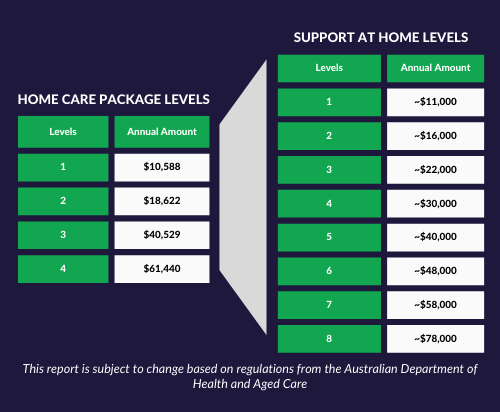
If you’re already on a Home Care Package, you’ll be allocated a new level that matches your current support.
Understanding Fees Can Be Confusing — That’s Why Support at Home Is Making Things Simpler
-
No more separate package management fees.
-
A flat 10% of your quarterly budget is set aside for care management, included in your hourly service rates.
-
No hidden costs or tricky percentages.
At Maree Care, your dedicated Care Manager will work with you to make sure you get the best value from your funding, and our team will keep you updated as regulations evolve.

Flexible Funding, When You Need It
Support at Home gives you more control over your funding:
-
Quarterly allocations: Your support budget is provided every three months, not monthly.
-
Save for the unexpected: You can keep unspent funds between quarters (up to $1,000 or 10% of your quarterly budget, whichever is higher).
-
Use your funds your way: Unspent funds can be used for ongoing services, or for equipment and home modifications if needed.
At Maree Care, we’ll provide regular, easy-to-understand statements and help you plan your spending to make sure you get the most out of your support.

More Services, More Choice
With the introduction of Support at Home, you’ll have access to a broader and more flexible range of services, carefully grouped into three main categories to better meet your needs and preferences. This new approach is designed to give you more control, greater choice, and tailored support-whether you’re already receiving care or just starting your journey with Maree Care.
- A new Approved Services List is coming, with 3 support categories (clinical, independence and everyday living).
- You can get up to $15,000 in additional funding for equipment and home modifications via the AT-HM Scheme.
- There will also be more funding to help you with Restorative care, End-of-Life care, and Dementia care.
- You’ll still be able to get other help too, like veterans’ support and oxygen therapy.
- There won’t be any limits on the number of hours you can use for gardening and cleaning services.
- All services will need to be processed through your Provider to ensure they meet the Support at Home quality standards.
- Whether you are Self-Managed or Fully Managed, you will need to have a minimum number of Care Management hours. This helps ensure you are receiving quality care in line with the Support at Home guidelines.

Approved Service List
The Approved Services List under the Support at Home program categorizes supports into three distinct and comprehensive groups, designed to address different aspects of your care needs:
Service Type | Contribution | |
Clinical | – Nursing Care – Allied Health and Other Therapeutic Services – Nutrition – Care Management – Restorative Care Management | Services are fully funded by the government |
Independence | – Personal Care – Social Support and Community Engagement – Therapeutic Services for Independent Living – Respite – Transport – Assistive Technology and Home Modifications | Services are not fully funded by the government |
Everyday | – Domestic Assistance – Home Maintenance and Repairs – Meals | Services are not fully funded by the government |
For a more details on the list of services, please refer to this
Participant Contribution Table
Your contribution towards the cost of your care depends on your income and pension status. The government funds most of your support, and we’ll help you understand exactly what you’ll pay.
Individuals who were approved for a Home Care Package (HCP) before the announcement, are receiving HCP services before 1 November 2025, and either currently pay or would pay an income-tested care fee under HCP, will be protected by the “no worse off” principle and will pay discounted contribution rates as outlined below.
Clinical | Independence | Everyday | |
Full pensioner | 0% | 0% | 0% |
Part pensioner | 0% | Part pensioners holders will pay between 0% – 25% based on an assessment of their income and assets. For part pensioners this will be based on their Age Pension means assessment. | Part pensioners holders will pay between 0% – 25% based on an assessment of their income and assets. For part pensioners this will be based on their Age Pension means assessment. |
Self-funded retiree (holding or eligible for a Commonwealth Seniors Health Card – CSHC) | 0% | CSHC holders will pay between 0% – 25% based on an assessment of their income and assets. CSHC holders will undergo a separate assessment for Support at Home. | CSHC holders will pay between 0% – 25% based on an assessment of their income and assets. CSHC holders will undergo a separate assessment for Support at Home. |
Self-funded retiree (not eligible for a Commonwealth Seniors Health Card) | 0% | 25% | 25% |
This does not apply to people who were approved for a Home Care Package after the announcement, who start receiving services from 1 November 2025 onwards, or who are not subject to an income-tested care fee. These individuals will not be eligible for the ‘no worse off’ protections or discounted rates
Clinical | Independence | Everyday | |
Full pensioner | 0% | 5% | 17.5% |
Part pensioner | 0% | Part pensioners holders will pay between 5%-50% based on an assessment of their income and assets. For part pensioners this will be based on their Age Pension means assessment. | Part pensioners holders will pay between 17.5%- 80% based on an assessment of their income and assets. For part pensioners this will be based on their Age Pension means assessment. |
Self-funded retiree (holding or eligible for a Commonwealth Seniors Health Card – CSHC) | 0% | CSHC holders will pay between 5%-50% based on an assessment of their income and assets. CSHC holders will undergo a separate assessment for Support at Home. | CSHC holders will pay between 17.5%- 80% based on an assessment of their income and assets. CSHC holders will undergo a separate assessment for Support at Home. |
Self-funded retiree (not eligible for a Commonwealth Seniors Health Card) | 0% | 50% | 80% |

Ready to Get Started or Have Questions?
Download Our Free E-Book
Free Report Reveals Untold Facts About Support At Home (And How Not To Lose Your Current Funding and Services)